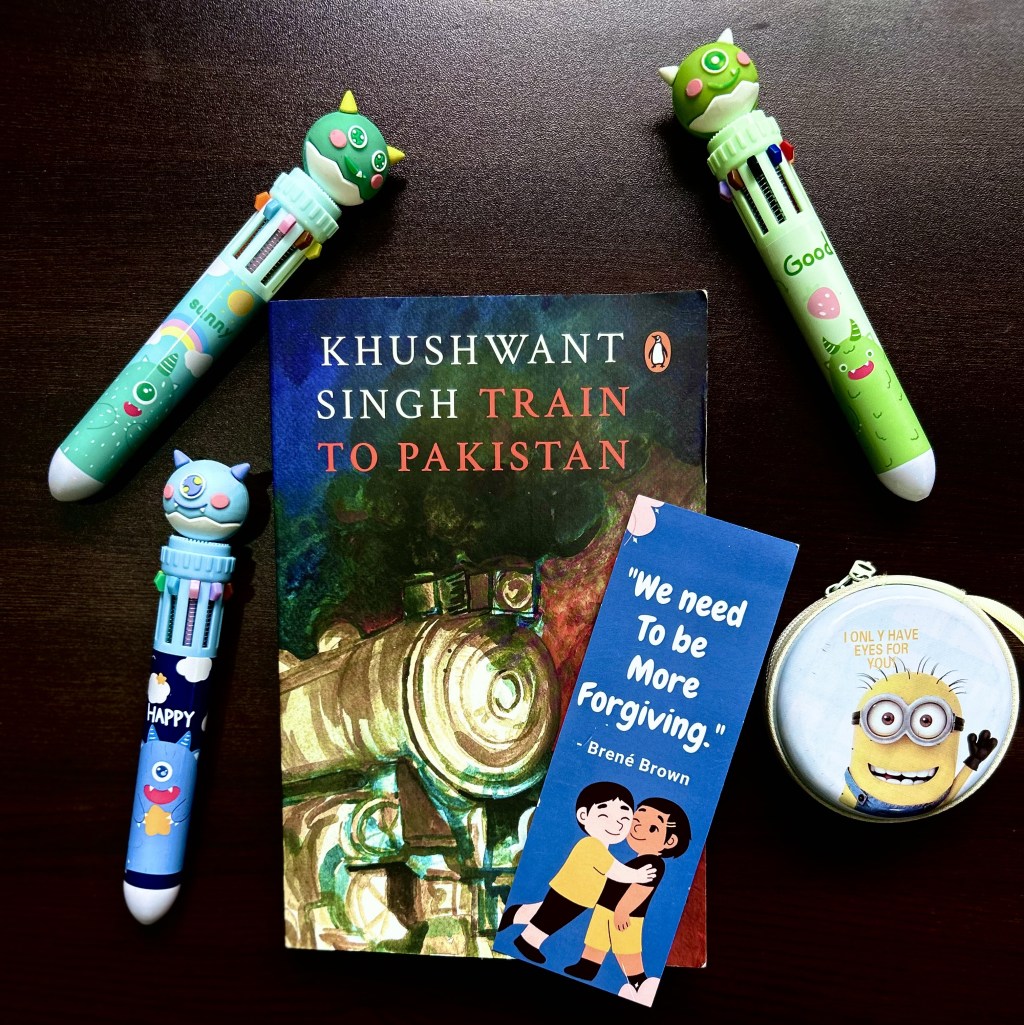
In the vast region of diversity what is that one factor that makes you stand out from the rest of the crowd ? House, bank balance or government job ? In my opinion I would say it is Knowledge and Education. Of course house and bank balance is necessary but without knowledge and education they won’t last long. A true human being are those who are grounded under the heavy weight of knowledge. I too am engaged in the perpetual journey of acquiring knowledge. So I picked up this book called “A train to Pakistan” by Khuswant Singh to understand the history of India during partition and see through the eyes of the author to better visualize their life.
Description –
Mano Majra, a small village situated on the border of India and Pakistan, was home to families of all religions. Where it was heavily crowded with Sikhs and Muslims but with a single Hindu family. Everyone was living a harmonious life until a train full of dead bodies arrived and halted at Mano Majra station. With a series of events and planned hoax the one person who could save the village was in jail without any evidence and the activist who doesn’t believe in any religion, though born in a Sikh family was taken into custody with the suspicion of being a muslim. How the chaos fell upon the village, how the bond between Sikhs and muslims broke with a series of lies and how a group of Sikhs conspired a plan to teach the muslims a lesson is what readers can get from the book.
My Review –
- I loved the way the book started. It has explained in minute details regarding the daily life of a typical Indian villager. It felt like while writing the book, the author had kept a halogen light in his hand and made it solely focus on each individual whether male, female or children to write thoroughly and accurately. I made personal notes in the book with sticky notes where I felt like this part can’t be described any other better way.
- The book is divided into 4 chapters and each chapter provides justice to its title. The book has evolved in such a way that a reader can engrossed him/herself till the end. I could visualize the entire event as if it was happening in front of me. Though I felt little disappointment at the end as I wasn’t expecting such a tragic end and I had to search if the book has ended here or any more pages available.
- The chaos and mass murders that happened during partition made my heart ache in pain for the families involved. Millions died and millions got lost in the crowd. People had to leave their ancestral houses, lands and cattles to move to a completely new region. After reading the book I prayed for those who have died and thanked God for letting me born into modern independent India.
- I saw the world from a religious aspect and learnt about Sikhs and their gurus and what few practices people from India follow of being a muslim. I learnt how life was without technology and smartphones. Village peepal trees and evening gatherings were the only source of collecting information from the outside world. So people from higher posts took advantage of the ignorance of innocent people to provoke them to do crime and other stuff for their own benefit.
- One thing I couldn’t understand was the role of the activist Iqbal. He came to the village, and the police took him into custody the very next day. When he got released chaos had already fallen upon the village. He came and thought of a few things and just slept through the chaotic night. So I felt the character didn’t have any impact. At least not to me.
Conclusion –
I loved the fact that the book sticks to the root of Indian culture. I could smell the soil when it rained in the fictional village. So you could feel my involvement in the book. The book can captivate your soul and let you visit and showcase the true essence of life which we have somewhat lost in our city life. Overall I enjoyed it, was happy to see the harmonious life among different religious people and it reminded me of my ground, culture and origins.
 www.the-storyteller.in
Leave a comment