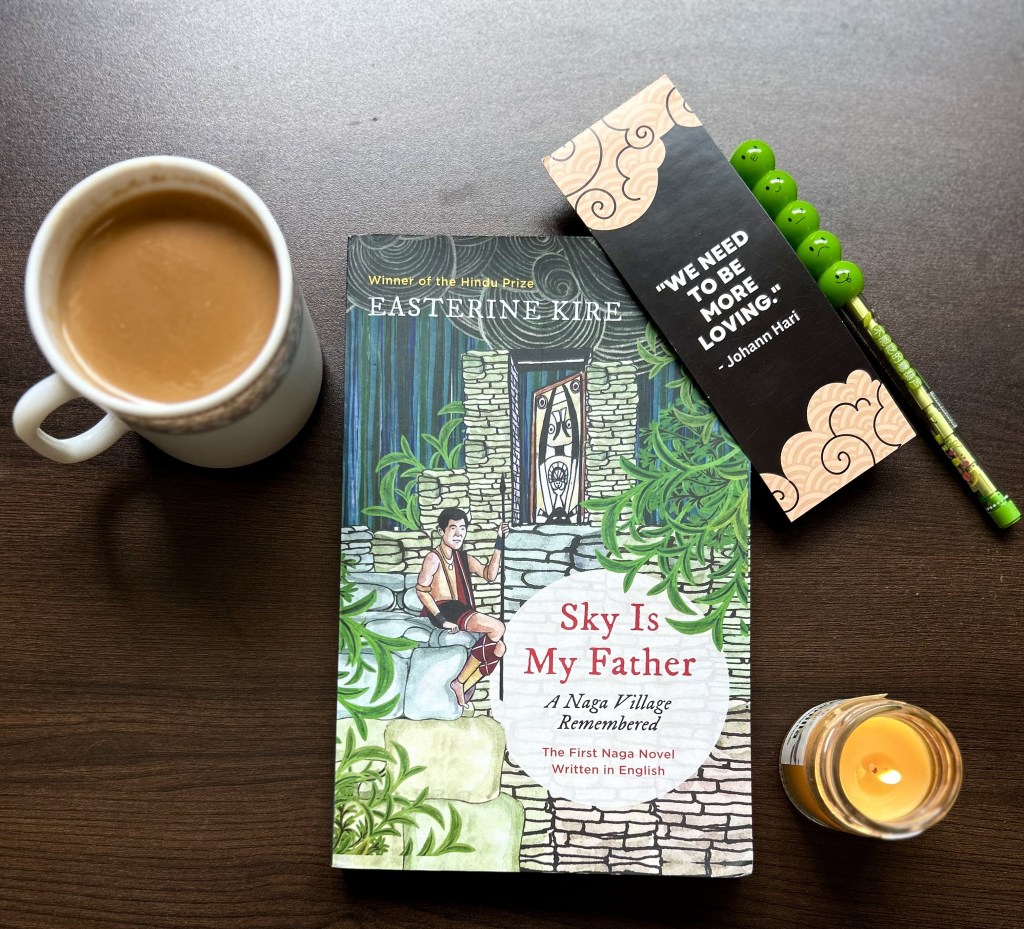
Being enthusiastic to gain more knowledge on different countries, people and their culture, brought me back to my own country India. Being a part of eastern India, I was curious about the lifestyle and culture of north east and voila, guess what I found in one of the book fairs that I attended recently. “Sky is my father, a Naga village remembered” by Easterine Kire. Without further ado, let’s dive into the book.
*If you need recommendations on books from different countries, check out the PS section of the same blog post.
About the book –
- Author – Easterine Kire
- Genre – Indian historical fiction
- Pages – 175
- Illustrator – Kavita Singh Kale
- Publication – Speaking Tiger
Description –
The story is about battle between Angami warriors from Khonoma, a small village in Nagaland with the British between 1832 and 1880. Despite being outnumbered and ill-equipped, the warriors battled neck to neck with the British for 4 long months, eventually signing the treaty on 27th March 1880. The story revolves around the Naga families and their lifestyles from child birth till death. The rituals everyone has followed and all kinds of social taboos and fears that led the village to abide by the rules. After the war and treaty was signed, Angami warriors became friendly with white people, especially the younger generation and started converting to christianity which later divided the village based on religious belief.
My Review –
- The book started with the introduction from the author herself. It depicts the entire events and battle that happened between the Angami warriors and the British to get the overall incidents to give a kick start to the readers.
- The chapters let the readers dive into a family in the village, their day to day life, different festivals they celebrated and rituals to follow upon death. The children who grew up hearing the stories of bravery of their ancestors and the eventful night when someone killed a tiger, social taboos and belief in spirits made me wonder about the lives without modern science and technology.
- After understanding the culture and the characters, when author explained the 4 months long battle, how Angami warriors went on raids, how they surrounded the British and put halt to their food and water supply, how they made surprise attack and their war strategy, I was very much impressed and could relate with the introduction that was mentioned in the start of the book.
- Author also explained Angami terms and ritual names at the end of the book which was very helpful to understand.
- The book also covered oral narratives from the recent natives who have figured out 500 years of ancestral history. Isn’t it wonderful to know your ancestors and have an idea on your origin ?
Highlight –
The 2 things from the book that caught my attention to pick this up are
- the cover illustration, and
- the information on the author that she is the winner of the Hindu prize.
The page cover is very catchy and gives a village vibe with jungle, bamboo, houses and outfit and style of people from eastern regions. The book illustration was done by Kavita Singh Kale. After reading this book I immediately started following her on instagram.
About the Author –
Author Easterine Kire, was born on 29 March 1959 in Kohima to an Angami Naga family from Kohima Village.
Easterine Kire’s “Son of the Thundercloud ” has been awarded Bal Sahitya Puraskar by Sahitya Academy in 2018. In 2011, Easterine Kire was awarded the Governor’s Medal for excellence in Naga literature. She was also awarded the Free Voice Award by Catalan PEN Barcelona. “Bitter Wormwood” was shortlisted for The Hindu Prize in 2013. “A Terrible Matriarchy” was selected to be translated into UN languages. Furthermore, the books “A Terrible Matriarchy”, “Mari”, “Forest Song”, “Naga Folktales Retold” and “A Naga Village Remembered” have been translated into German. In 2015, her “When the River Sleeps” was awarded The Hindu Literary Prize.
*About the author section, reference has been taken from Wikipedia.
Conclusion –
Overall, the book has provided justice to the characters and Angami warriors. It has shown a true portrayal of the lives and let the people judge how it was in the old days. I loved how the book started with a family and included lots of people from the village eventually their death. The love and respect they had for each other and the pride of being a warrior was very much overwhelming. Illustration, blurb, glossary of Angami words, oral narration, everything was fabulous and I enjoyed the historical journey throughout the book.
*PS: As promised, here are some book recommendations to know more about different countries, their history and culture.
1. Before the coffee gets cold series by Toshikazu Kawaguchi (Japan Literature)
2. The seven moons of Maali Almeida by Shehan Karunatilaka (Sri Lankan civil war)
3. The paper wife by laila Ibrahim (Chinese Immigration)
4. The stationary shop of Tehran by Marjan Kamali (Iran political outrage)
5. The tattooist of Auschwitz by Heather Morris (Germany Nazi Holocaust)
 www.the-storyteller.in
Leave a comment